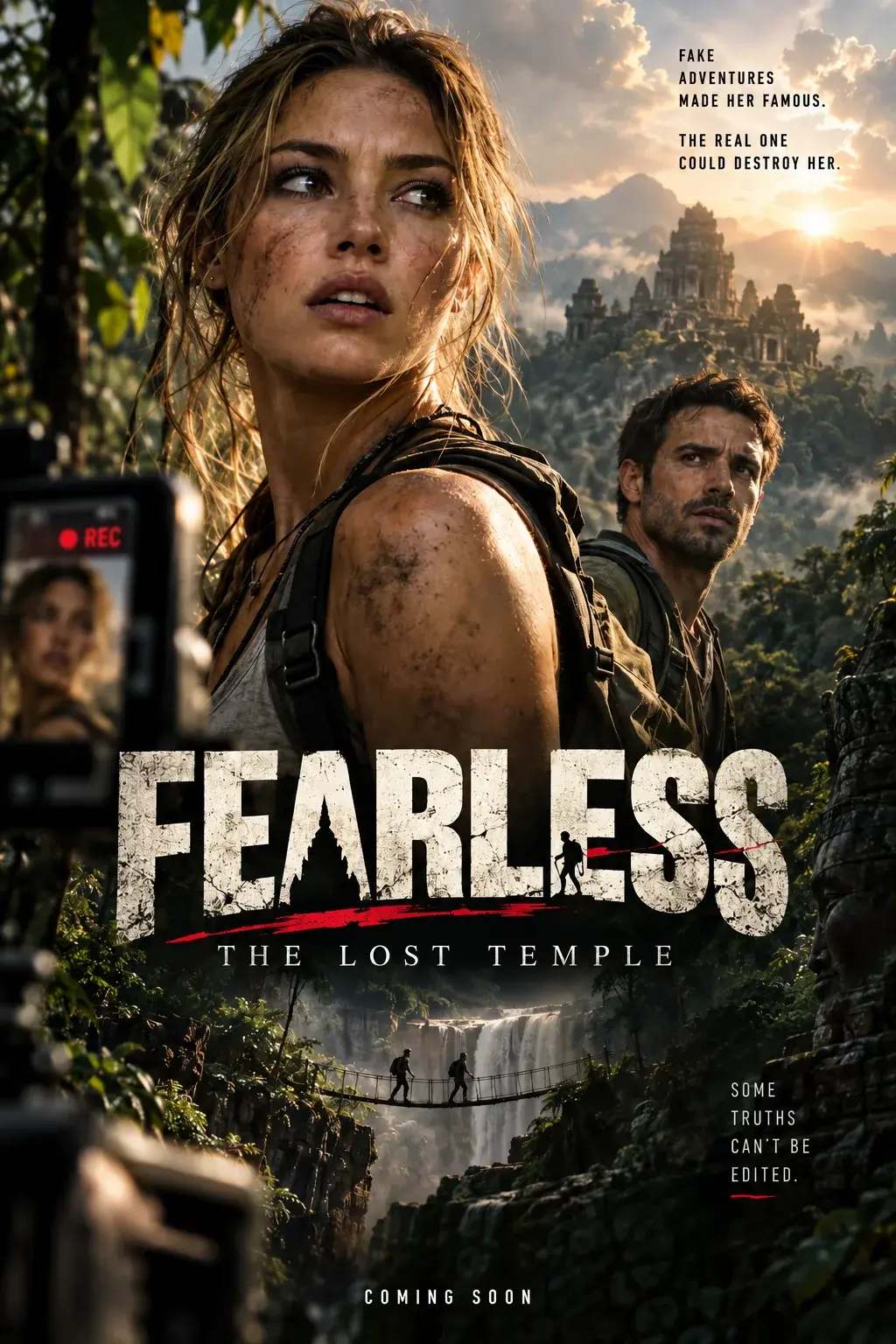
Avery Blake, a disgraced travel influencer who gets caught faking her “Fearless” adventures, records a public mea culpa: she faked her bestselling book's signature adventure searching for a legendary temple in Northern Thailand from her backyard. To prove it, and save herself from lawsuits and her father's mounting care costs, she's forced to do it for real, live-streaming the entire trip, unedited, camera she doesn't control. Her audience, mostly hate-watching at first, waits for her to fold.
She's paired with Connor Storm, a guide with a reputation for never missing a client, except he's not at the airport when she lands. It's a test, we later learn: he's watching from a bar he knew she'd find her way to, gauging whether she's resourceful enough to be worth his time. What Avery doesn't know is that Connor isn't really a guide-for-hire anymore. Three years ago, his source and friend Lek was murdered after Connor published his name in a story about illegal logging - the logging operation simply relocated and kept operating. Connor has spent three years quietly tracking that operation's new base, certain it's hidden somewhere near the same temple his old maps pointed to. Avery's fame and her broadcasting deal are perfect cover: a camera nobody would suspect, cutting straight into territory he could never reach alone.
The publisher, meanwhile, has hired two men to manufacture "excitement" along the early trail to boost viewers rigged trap here, a staged scare there. After Avery's viewership goes flat somewhere around day four of unbroken jungle trekking. It works, for a while. Engagement climbs. Then, somewhere past the last village with any modern trace of civilization, the traps stop being staged. Charles (the publisher) watches from the boardroom, realizes with dawning horror that he paid people only through the last village, whoever's laying traps now isn't on his payroll. The real operation has eyes on them, and has for longer than anyone realized.
The journey itself escalates visibly: paved roads to tuk-tuks to river boats to game trails, villages with televisions and motorbikes giving way to villages with neither, until there's nothing but jungle and a compass. The villages along the way aren't uniform in how they treat the travelers . Some welcome Connor as a known, trusted face; others, closer to the logging operation's reach, beg him to leave before he brings trouble down on them. Their water is being diverted. Their young men have been "recruited" and don't come back. The Elders know exactly who's operating in these hills, and some of them have been quietly waiting for someone like Connor to finally do something about it.
Along the way, Avery and Connor fall into the expected antagonism-to-intimacy arc, but the pressure-tests of the trail (a booby trap, a river crossing, a night in a shared tent) reveal a version of Avery who is more capable than she's letting anyone believe, including herself, while Connor's evasiveness about his "real" reasons for being here starts to read as more than just guilt. Midway through, in the village, after they've kissed, Avery presses him about Lek and gets the true story: he didn't just get his source killed, he's been hunting the people responsible ever since, and the temple search was never really about the temple.
That confession changes the shape of the second half. Avery, furious at being used as bait without her knowledge, has to decide whether to keep broadcasting a manhunt she didn't sign up for and whether the man she's fallen for used her the same way her publisher always has. The livestream, meanwhile, becomes a genuine character in the story: it cuts out entirely during the most dangerous stretches (a ravine climb, a night hiding from patrols), leaving her audience and the world speculating in real time, scroll comments running the gamut from mockery to disbelief to real fear for her safety. Public opinion pivots hard, from "what a fraud" to "holy shit, this is real," and that external pressure becomes its own kind of stakes: the world is now watching Connor's private war whether he wanted them to or not.
They reach the temple's territory to find it's not a fixed, permanent structure so much as a phenomenon, visible in full only during a narrow seasonal window, when light (or the diverted, now-returning water) reveals what's otherwise hidden behind rock and waterfall, Newgrange-style. It's not gold inside. It's a chamber that briefly looks like gold when the light and water align. And it sits, as Connor suspected, directly above the logging-mining operation's hidden base. The local Elders have known for years, and have been protecting the secret specifically to keep the operation from ever finding a reason to dig deeper into these hills.
The convergence happens at the climax: Connor's real target, the camp, and the men responsible for the death of Connor’s friend Lek is exposed at the same moment the temple's phenomenon becomes visible, with Avery's live feed capturing all of it, unedited, to the largest audience she's ever had. She has the choice to cut the feed and protect herself, or let the world see everything, including things that implicate her publisher and endanger her own comeback narrative. She chooses to let it run. The operation is exposed and dismantled, not by Connor going full vigilante, but by the combination of local testimony, Connor's evidence, and a global audience watching live, which finally does what Connor's original story never managed to. The temple itself isn't destroyed. It's protected and the question the whole film has been circling (does visibility save sacred things or destroy them) resolves in favor of visibility used honestly, in public, with the community's consent, rather than a self-interested reveal.
The epilogue lands months later: Avery has genuinely changed, not performing anymore, using her platform only when something true needs saying. Connor has some form of closure on Lek, not through revenge but through actually finishing what his reporting started. And the village, no longer under threat, has its water and its temple back and protected because the right people, for once, decided together how the world should be allowed to see it.